ServicesCustom business applicationMargin, projects, teams, invoices: software that is yours.AI and automationReminders, reports, website enquiries: handled without a second thought.Dashboard and business reportingRevenue, margin, unpaid invoices, every morning.Website and application packageBoth designed together and connected.Website designBuilt to be found and to bring in enquiries.Website redesignRebuilt without losing your search rankings.SEO (search engine optimisation)Climb the searches for your trade.All our servicesEverything we offer.
IndustriesConstruction & ArchitectureArchitects, engineering consultancies, constructionHVACRefrigeration, HVAC, heat pumps, solarTransport & mobilityTaxi, private hire, removals, freightResellers & installersTills, kiosks, payments, securityConsulting & CoachingConsultants, coaches, agenciesTraining & PublishingTrainers, online course creatorsTech & B2B SaaSStart-ups, software publishers, industryFranchise networksFranchisors, multi-unit franchisees
Our workPricing
ResourcesWhat a website costs in 2026The budget guide, item by item.Writing your project briefThe simple 7-point template.Choosing the right web agencyThe right questions to ask.All resourcesGuides, glossary and blog.Redesign: where to startThe steps, in the right order.WordPress, Webflow or FramerAn honest comparison of the three tools.The web glossaryTerms explained without jargon.The blogAll our articles.
ToolsA real audit of your websiteA score out of 100 and fixes, in 30 seconds.Competitor comparisonYour website against two competitors, criterion by criterion.Budget calculatorA detailed estimate, line by line.Project briefA document ready to send to suppliers.The cost of your organisationTime lost each year, costed in six questions.
About
FREN
Book a call
Book a call
Our work About Blog Book a call
Showcase website · Metalwork

How do you make know-how that shows on site visible online?

Visit the website
Section du site Accrometal
Overview

A metalwork firm that designs, fabricates and installs.

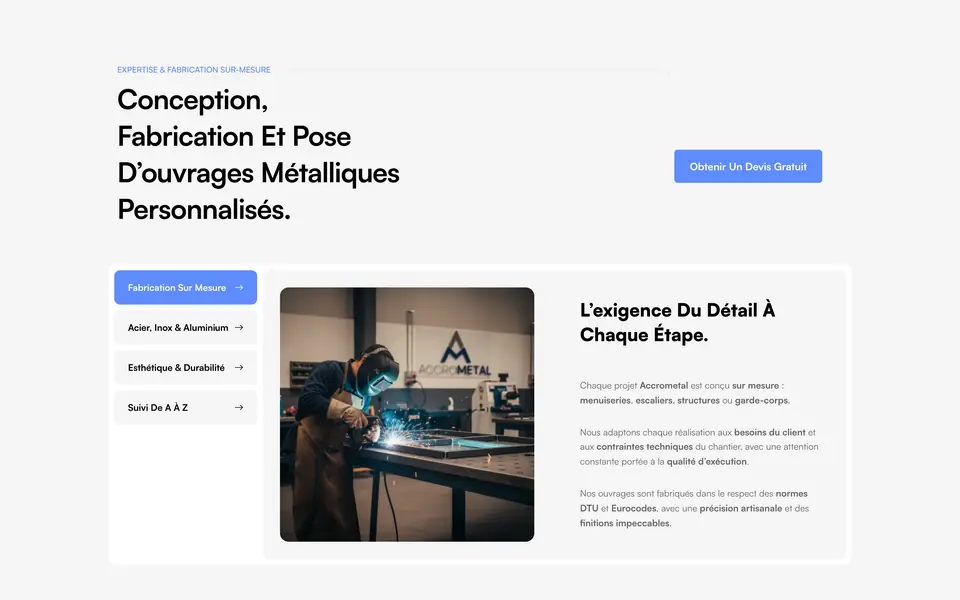
Accrometal designs, fabricates and installs structures, joinery and staircases in steel and stainless steel, for private clients and professionals alike. It is a trade where quality is visible on site, but stays invisible online until someone shows it. The website had to make a technical offer easy to understand, and turn a visit into a quote request.

Context & challenges

Know-how that did not show online.

Custom metalwork sells on trust. A client ordering a stainless steel staircase or a glazed partition commits a significant budget to a piece that does not exist yet. Before asking for a quote, they want to know who they are dealing with and what the company can really do.

The problem is a classic one in technical trades: the company has the skills, but its website does not prove it. Skills are listed without being explained, past projects are missing or buried, and visitors leave without understanding what sets this company apart from the next. To avoid this pitfall, the home page had to:

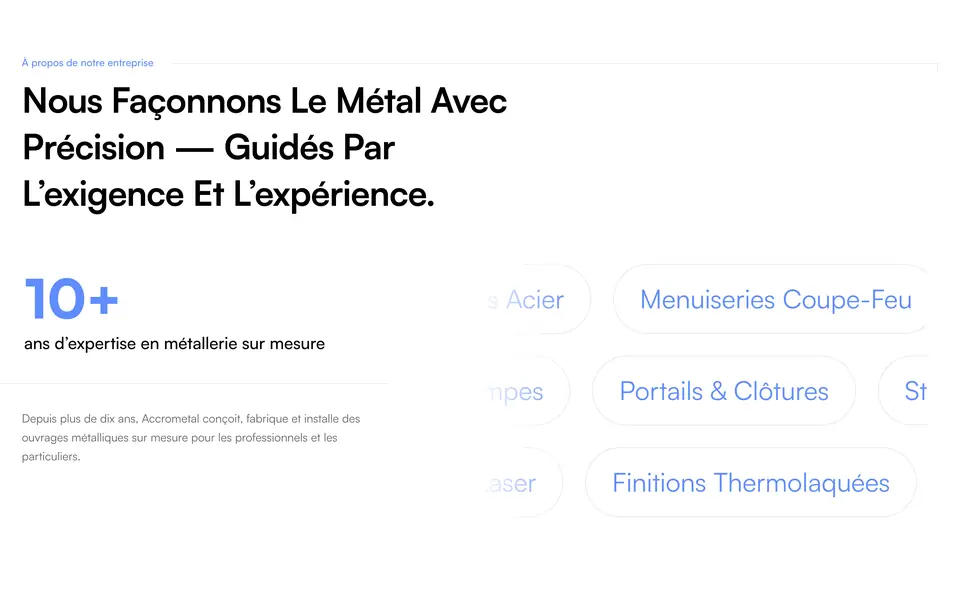
  • Make the offer clear: fire-rated doors and frames, glazed partitions, balustrades, gates, powder-coated finishes, design studies.
  • Say who you are dealing with: a French company, its commitments and its method, before any request.
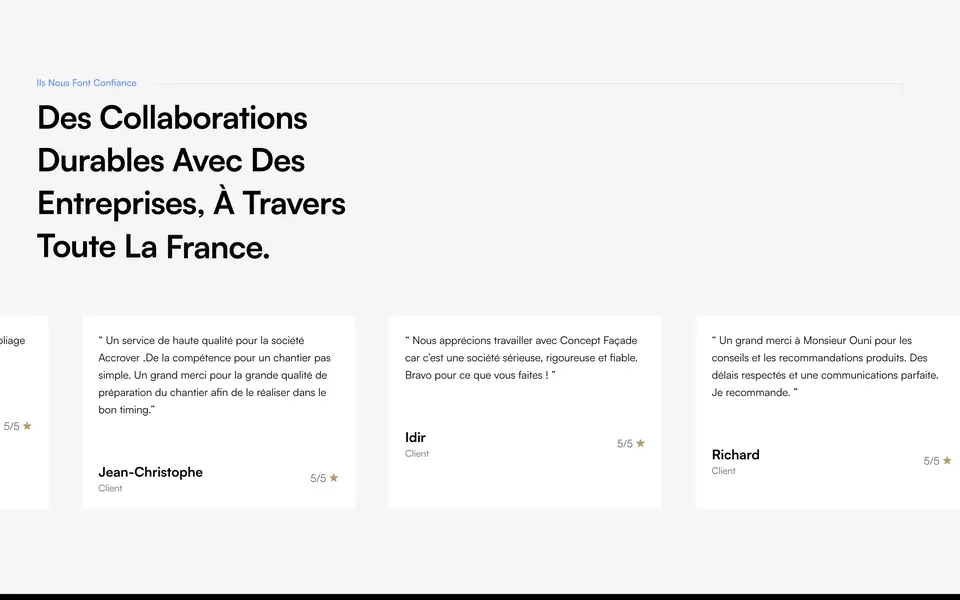
  • Show proof: finished work rather than promises.
  • Lead to the quote: without visitors having to look for how to do it.
Our role

A showcase website, from mock-up to launch.

We ran the project from mock-up to launch. The mock-ups were approved before development, which meant the structure and content of the home page were fixed before anything was built.

The home page was then built in WordPress with Elementor, from the approved mock-ups. The copy was written with the searches clients make for each type of work in mind, from fire-rated doors to gates, so that the offer is named precisely.

  • Mock-ups: approved before development.
  • Build: WordPress and Elementor.
  • Copywriting and SEO: content written for the searches on each type of work.
Section du site Accrometal
Approach & methodology

The quote one click away, everywhere.

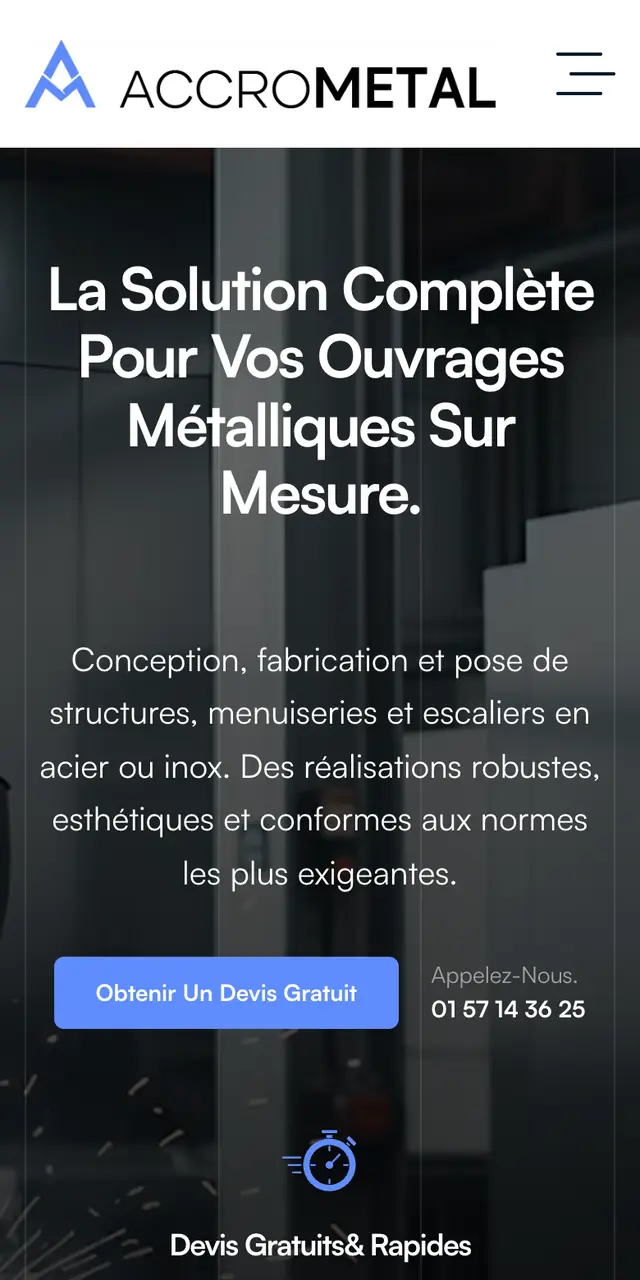
In this market, many clients would rather call than fill in a form. So the phone number appears on the very first screen, next to the quote button, and the quote request stays one click away throughout, from the header as well as the footer.

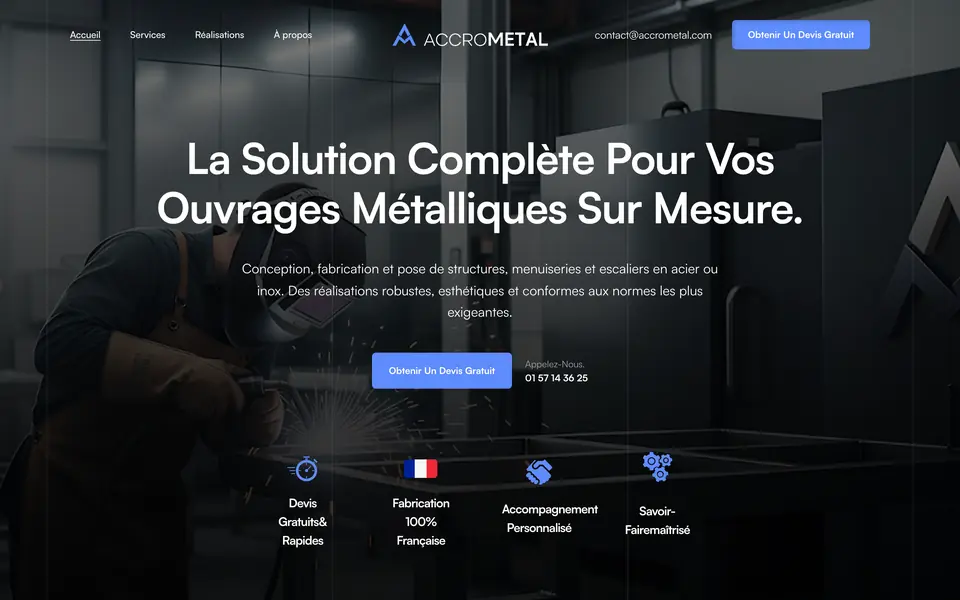
The commitments come next, in plain terms: fast, free quotes, made in France, personal support, proven know-how. Then the past projects take over, because finished work convinces a hesitant client better than promises. The home page gives the answers in the order in which the client asks the questions:

  1. Announce: “The complete solution for your custom metalwork”, with the quote and the phone number on the very first screen.
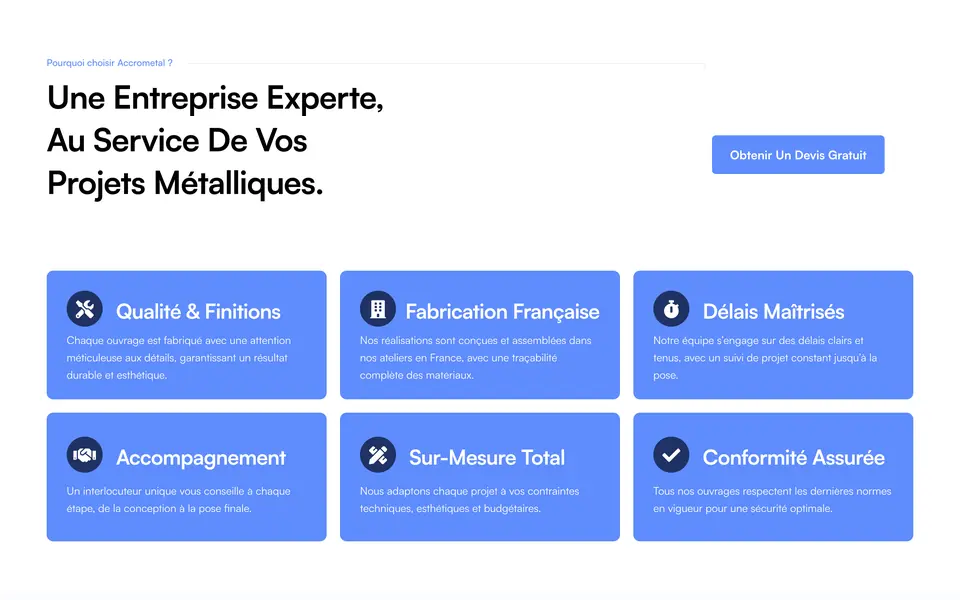
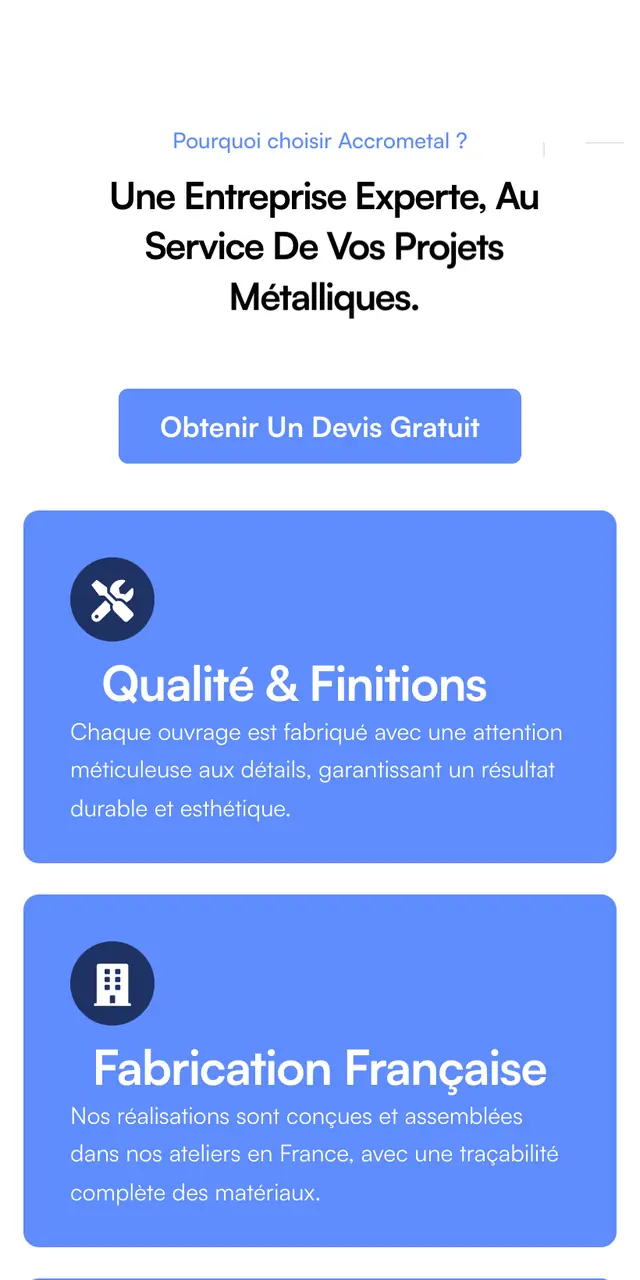
  2. Reassure: fast, free quotes, made in France, personal support, proven know-how.
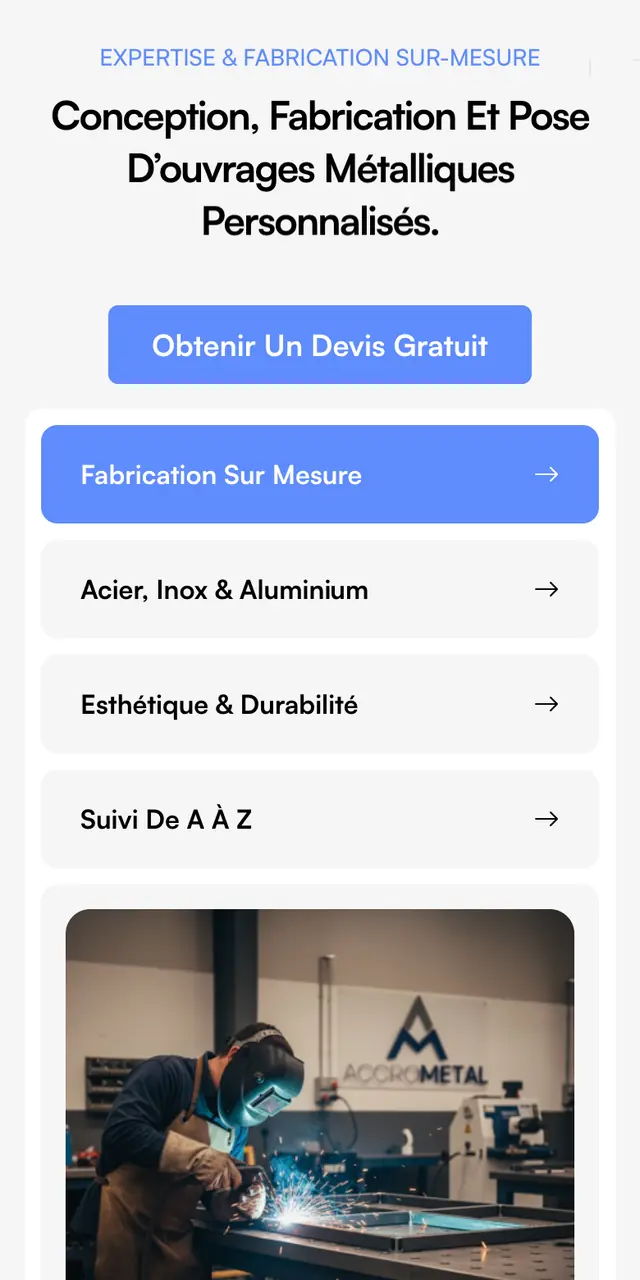
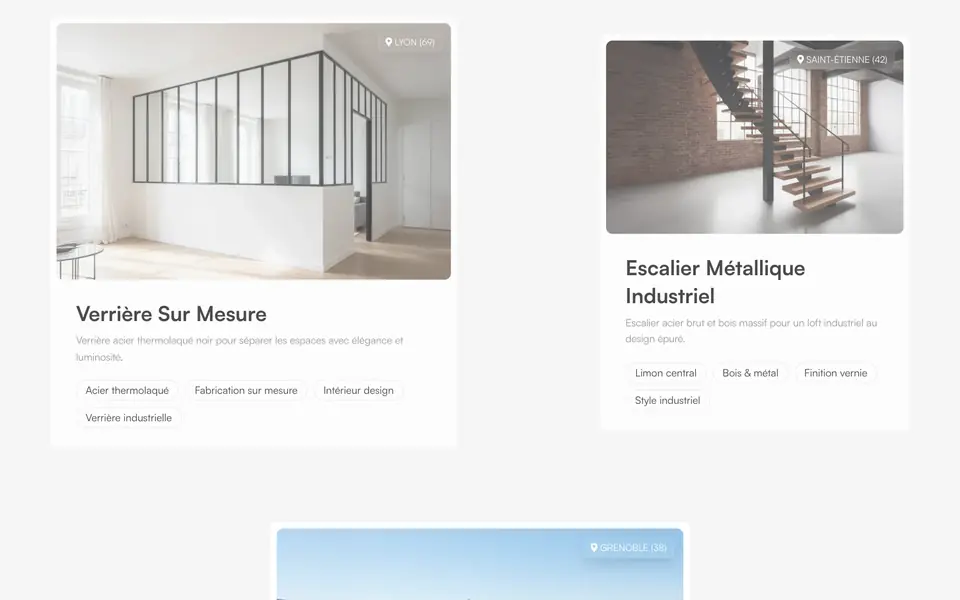
  3. Show: the families of work, then the completed projects.
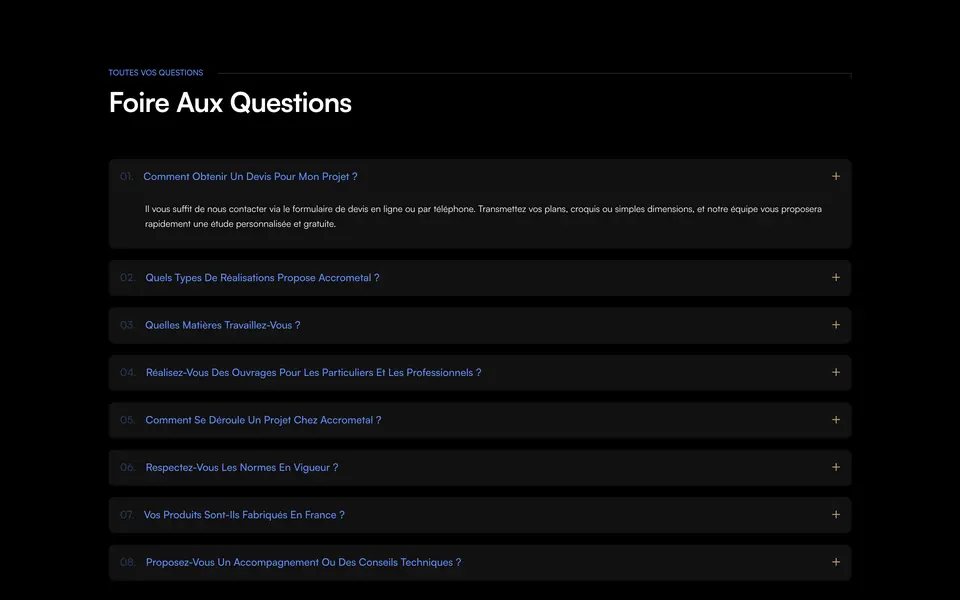
  4. Remove doubts: an FAQ on quotes, the materials used and the standards, then the request form.
Solutions & art direction

A restrained identity, a bold blue.

The identity stays restrained, with no unnecessary effects, and a bold blue that structures the page. The dark hero uses a photo of the workshop: visitors immediately see a place where things are made, with a large headline and the commitments summed up in icons.

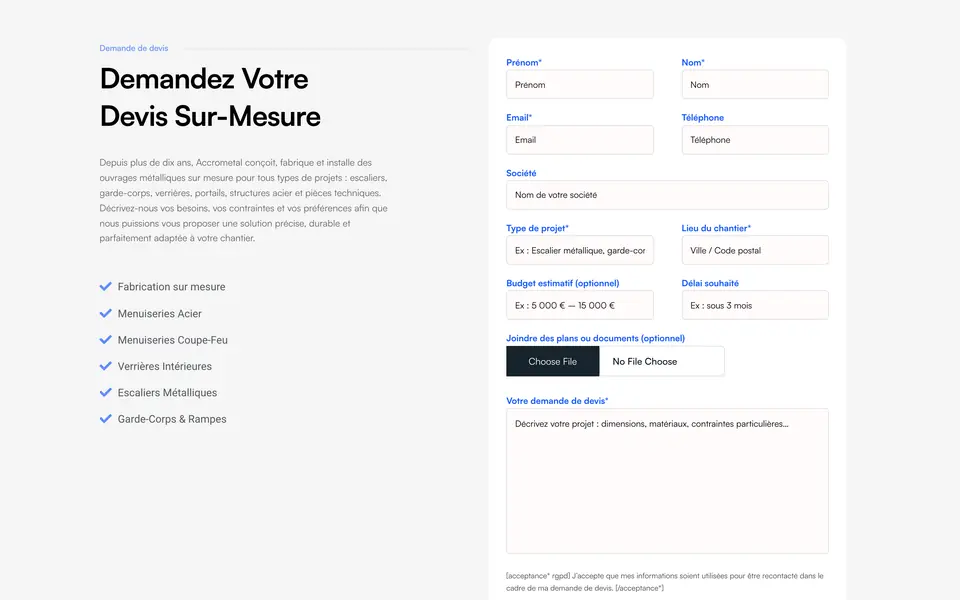
The quote form is detailed on purpose. Type of project, site location, preferred timescale, plans upload: this information lets the company understand the request as soon as it arrives, and lets clients describe their project without waiting for a first call.

  • A dark hero: workshop photo, large headline, commitments as icons.
  • Commitment cards: quality and finishes, made in France, lead times, support, made to measure, compliance.
  • Past projects on display: the finished work serves as proof.
  • A detailed quote form: type of project, site location, preferred timescale and plans upload.
Version mobile du site Accrometal
Section du site AccrometalSection du site Accrometal
Section du site Accrometal
Conclusion

A website that describes the company and leads to the quote.

Accrometal now has a website that presents its technical offer clearly and places the quote request at every stage of reading. Visitors understand what the company does, see its work and find the quote or the phone number without having to look for them.

That is the difference between a website that simply describes a company and a website designed to receive enquiries: it explains first, proves through completed projects, then offers contact at the moment the visitor is ready.

What if your website worked for your growth too?

A fast website, designed to convert, that stays in your hands: the code and the data belong to you. Thirty minutes to scope your needs and come away with a clear plan.

Book a 30-minute call

4.8/5 on Google · more than 100 projects delivered

We can hear you from here.

What you might be thinking

Too expensive compared with what? A website that does not convert costs you lost quotes every month. Hours spent re-entering data, chasing and searching for a file cost just as much, without ever showing up on an invoice. Our prices are stated before we start, and you can judge the work before committing: a trial mock-up at €390 for a website, a scoping session at €490 for software, both deducted from the project. We do not start anything until that calculation seems obvious to you.

The right time is before you are overwhelmed, not during. A website is delivered in 14 days. For software, the timeline is fixed in writing at the scoping session. In both cases, we take on most of the work. And if you are going through a busy period, we plan the start date with you rather than rushing you.

If your website brings you regular enquiries and your tools keep up, keep them. If your team juggles spreadsheets, emails and paperwork, or if you no longer dare to show your website, it is quietly costing you. The first call is there to tell you honestly whether it is better to keep, improve or rebuild. Sometimes we advise a simple touch-up rather than a full project.

At first, yes. After that, you pay a per-user subscription that rises as your team grows, for a tool that imposes its own way of working and of which you only use a part. Custom software does what you need, nothing more, and it belongs to you. It is the same reasoning as with business premises: renting costs less in the first month, rarely over ten years.

That is why everything is written down before we start: what we deliver, at what price, by when. A single point of contact, steps approved one by one and 30 days of iterations included. Nothing is coded before you approve it. You keep every project document, and nothing important is decided verbally.

We need a scoping call, a few approvals and your content. For software, we start from the way you work today: you show it to us, we turn it into a tool. You decide, we build. In practice, most of your time goes into the scoping session, and the approvals after that are short.

You approve the mock-ups before any development, and you get 30 days of iterations included from the date the quote is signed. We keep reworking until you approve, within the scope agreed together, with no charge for revisions. And if the art direction does not suit you, we rework it before writing a single line of code.

No. Your website and your software belong to you, code and data included. You are trained to use them, and another professional can take over if you decide to. Access details, hosting and documentation are handed over to you on delivery, with nothing held back.

You choose. We can handle everything, hosting, backups and updates, or hand you the keys so that your usual provider can take care of it. Either way, access is in your name from day one, and you can change your mind along the way.

That is planned for. Custom software can be changed: we add a step, a field, a role, without rebuilding everything. Each change is priced separately and you decide whether it is worth the cost. That is the difference with an off-the-shelf tool, where you wait for the vendor to have the same idea as you.

Often, yes. We start by looking at what exists: what holds up, what is worth keeping, what costs more to fix than to rebuild. That is exactly what the scoping session is for, and sometimes it concludes that there is not much to throw away.