Book a call


Bi-Niyati makes it possible to carry out, from a distance, donations that carry strong symbolic meaning. We built three funnels for them: the Eid al-Adha sacrifice, carried out in the donor's name in Tanzania; the food parcel challenge for families in Zanzibar; and the planting of fruit trees in Zanzibar, as an ongoing charity. With this kind of donation, the slightest ambiguity makes people give up.
Each funnel follows the same path, a page that explains, a payment page, a thank-you page, and the same promise: a personalised video sent to the donor as proof. The details below take the fruit trees as an example.
A remote donation requires trust. The donor pays for a tree they will not see planted, far from home, in Zanzibar. The journey had to build that trust step by step, not take it for granted.
The question the donor asks is not only a commercial one: how can I be sure it will be done, and done properly? The journey had to answer it before payment, and give a reason to act now rather than put off the gesture until later:
We built the three funnels from end to end, then produced the visuals and video edits that feed them. The content is part of the system: without images of the plantations, the promise would stay abstract for the donor. The visuals are also used in the campaigns that lead to the funnels.
The journey was shortened as much as possible: understand, choose, give. Each step must remove a doubt rather than add an argument, because with a remote donation, a single unanswered question is enough to make people give up. The build uses WordPress, with HTML, CSS and PHP.

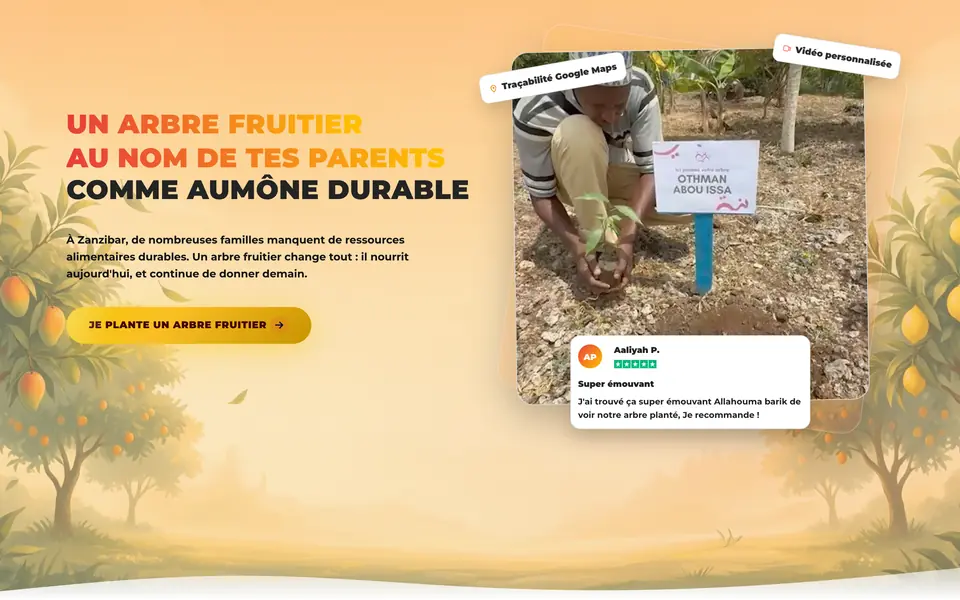
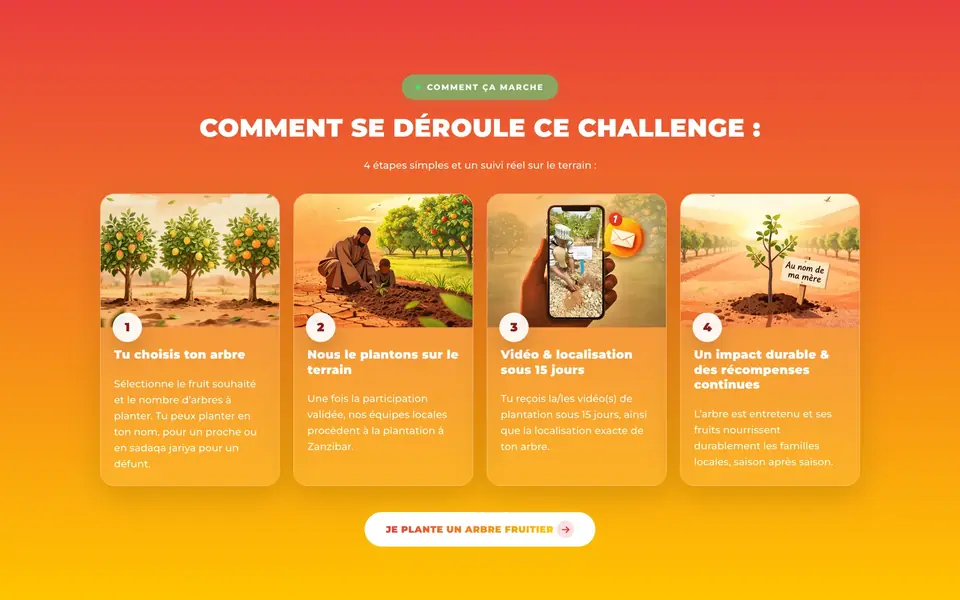
The proof is announced before payment, not after. Donors know what they will receive once their donation is paid: the personalised video of the planting and its location on Google Maps. These are what turn an invisible gesture into a verifiable commitment, and make the donation tangible.
The monthly target gives the journey a deadline. Donors see how far the campaign has come, then choose their variety and their intention without leaving the page, and finally find the reviews and frequently asked questions to clear up any last doubts. The page follows the donor's path:
Each module answers a specific doubt. The progress bar shows that the campaign is moving forward, the guided choice stops people getting lost between varieties and intentions, and the video sent to the donor confirms that their tree has actually been planted.
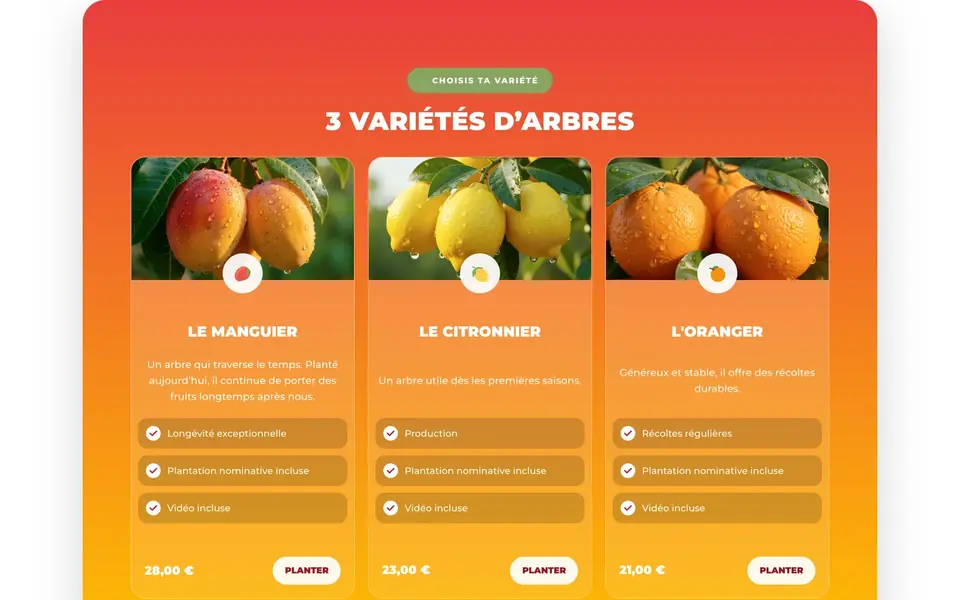
The art direction supports this message. The orange gradients and illustrations recall the fruit, and give the journey a warm tone that matches the gesture: a donation made in one's own name, in the name of one's parents or of a loved one.
The frequently asked questions play a double role. They clear up the donor's doubts on the page, and they are described for search engines, which makes them readable by Google and by AI assistants looking for a precise answer to a question.
The site structure is declared in the same way, with its breadcrumb trail and a description of the organisation. A dedicated image accompanies shares, so that the page stays readable when it circulates on social networks or in a messaging app. What can be checked on the website today:
For each donation, a page that explains, a payment page and a personalised video sent as proof.
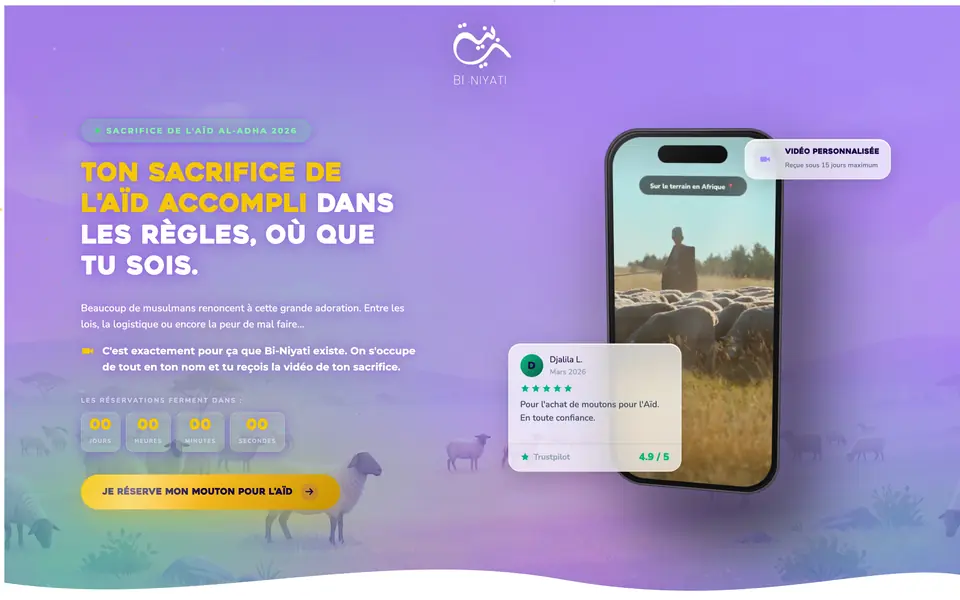
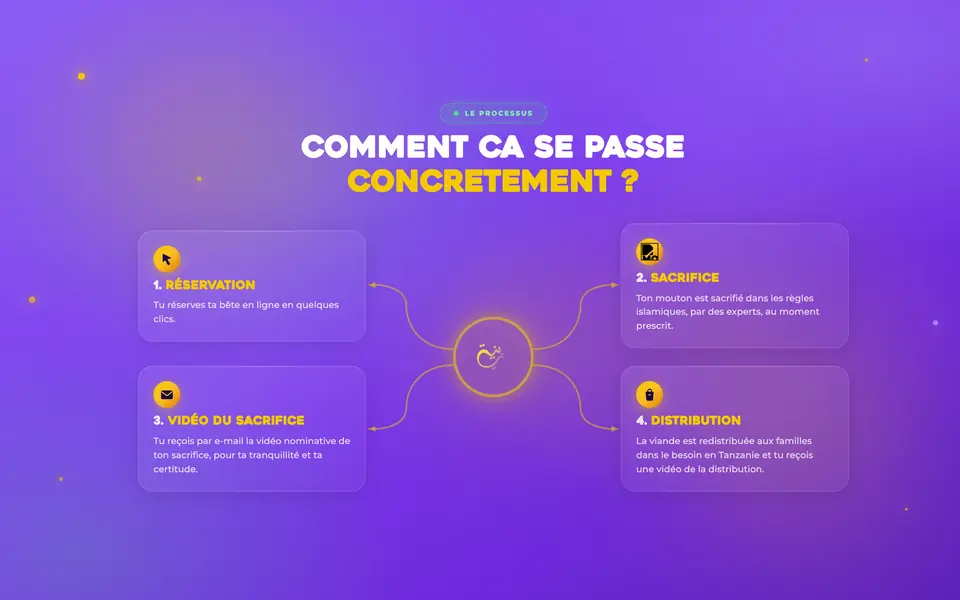
Reserve a sheep in a few clicks: the sacrifice is carried out in the donor's name, the meat given to families in Tanzania, and the video sent to the donor.


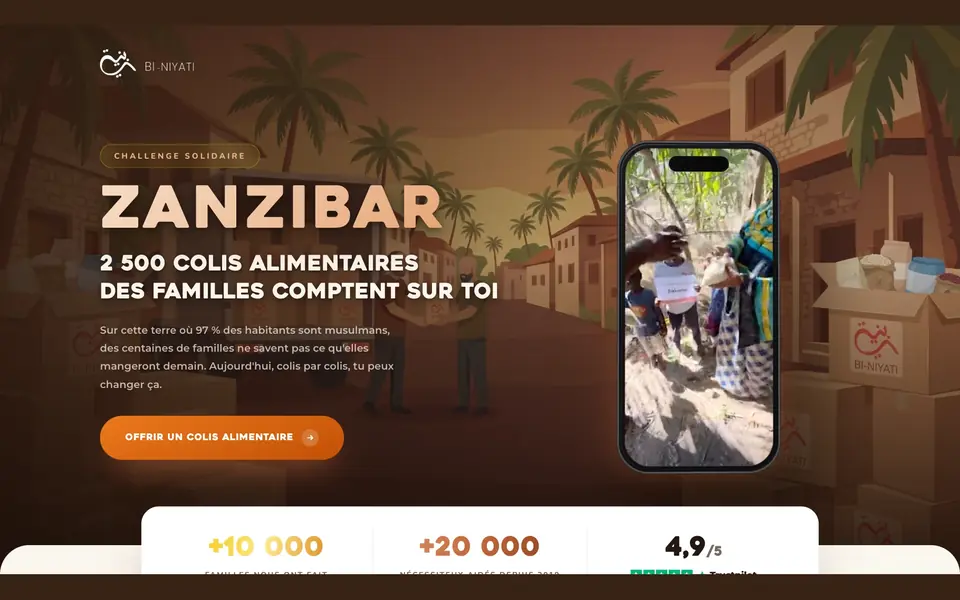
Give a parcel of rice, flour, sugar and beans: a shared progress bar, the choice of intention, then the video of the handover.


Plant a mango, lemon or orange tree in your name, with the video of the planting and its location.


Bi-Niyati now has three funnels and the content that feeds them: visuals, video edits and donation journeys. Each step aims to make the donation visible, from intention to planting, and to answer doubts before payment.
Its founder, who has been working with us for several months, speaks of work that is “innovative and right at the heart of the trends that make a difference, whether for a website or for visual content”. A remark that covers both sides of the project: the funnels and the content that feeds them.
“I have been working with Yanis from Widesign for several months, and the bottom line is that I am always satisfied with his work! His work is innovative and right at the heart of the trends that make a difference, whether for a website or for visual content. I really recommend his work. Thanks again, Yanis!” “Very professional
A fast website, designed to convert, that stays in your hands: the code and the data belong to you. Thirty minutes to scope your needs and come away with a clear plan.
4.8/5 on Google · more than 100 projects delivered

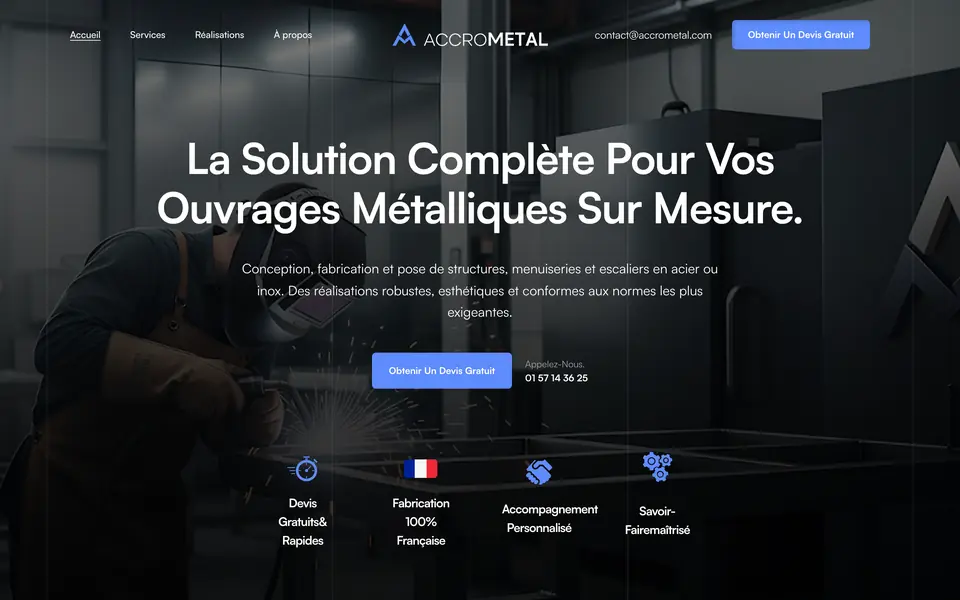
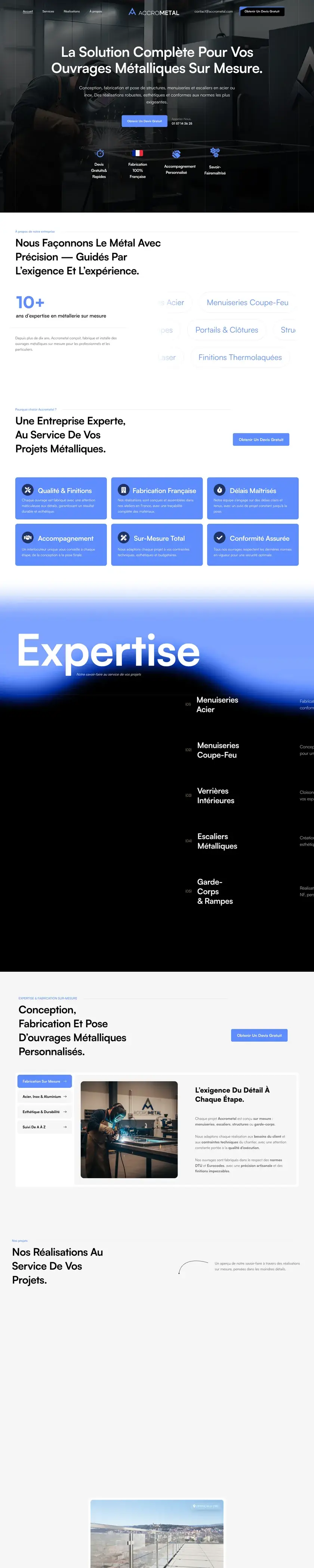
AccrometalHow do you make know-how that shows on site visible online?Showcase website · Metalwork
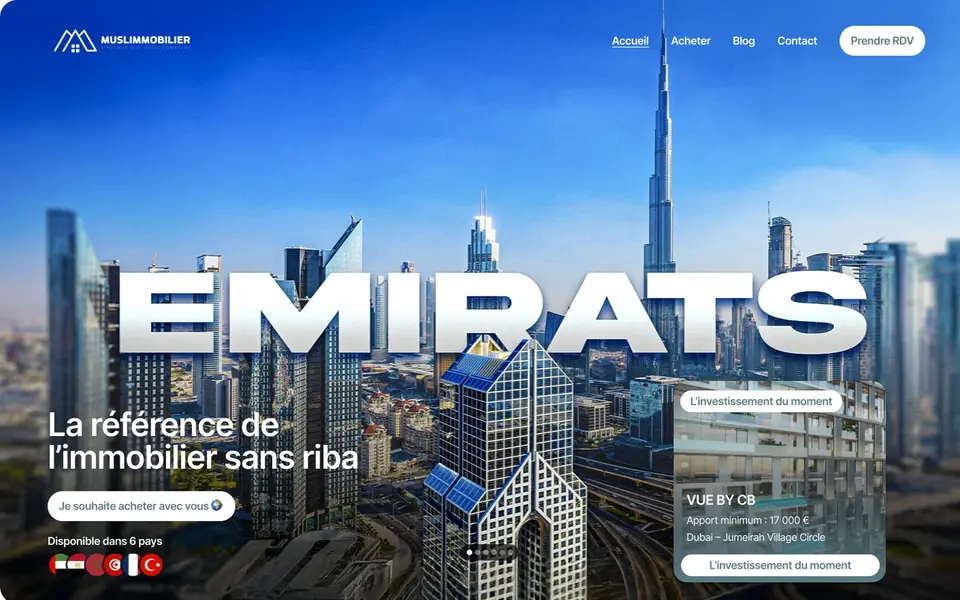
MuslimmobilierHow do you present properties when compliant financing comes first?Redesign mock-up · Real estate
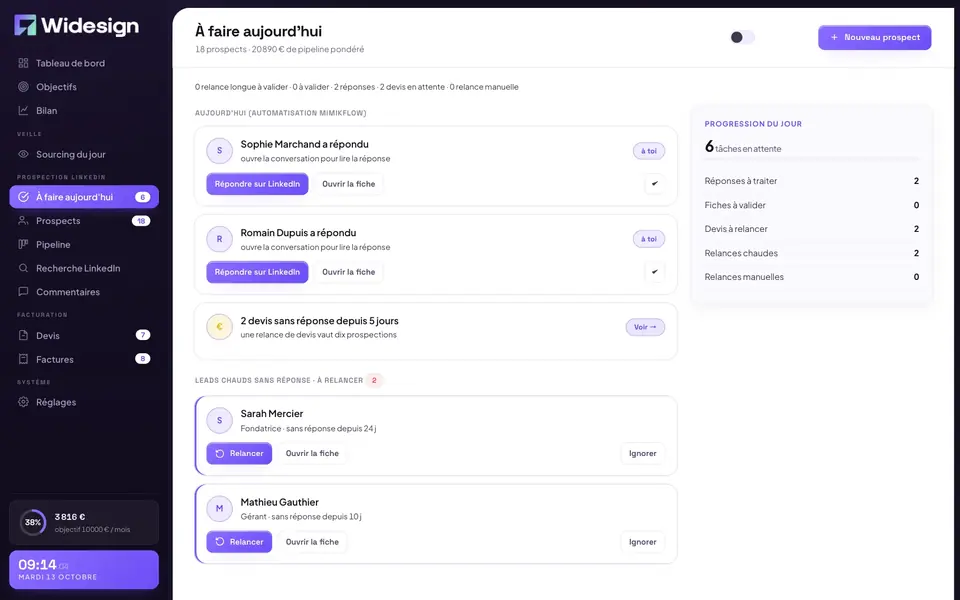
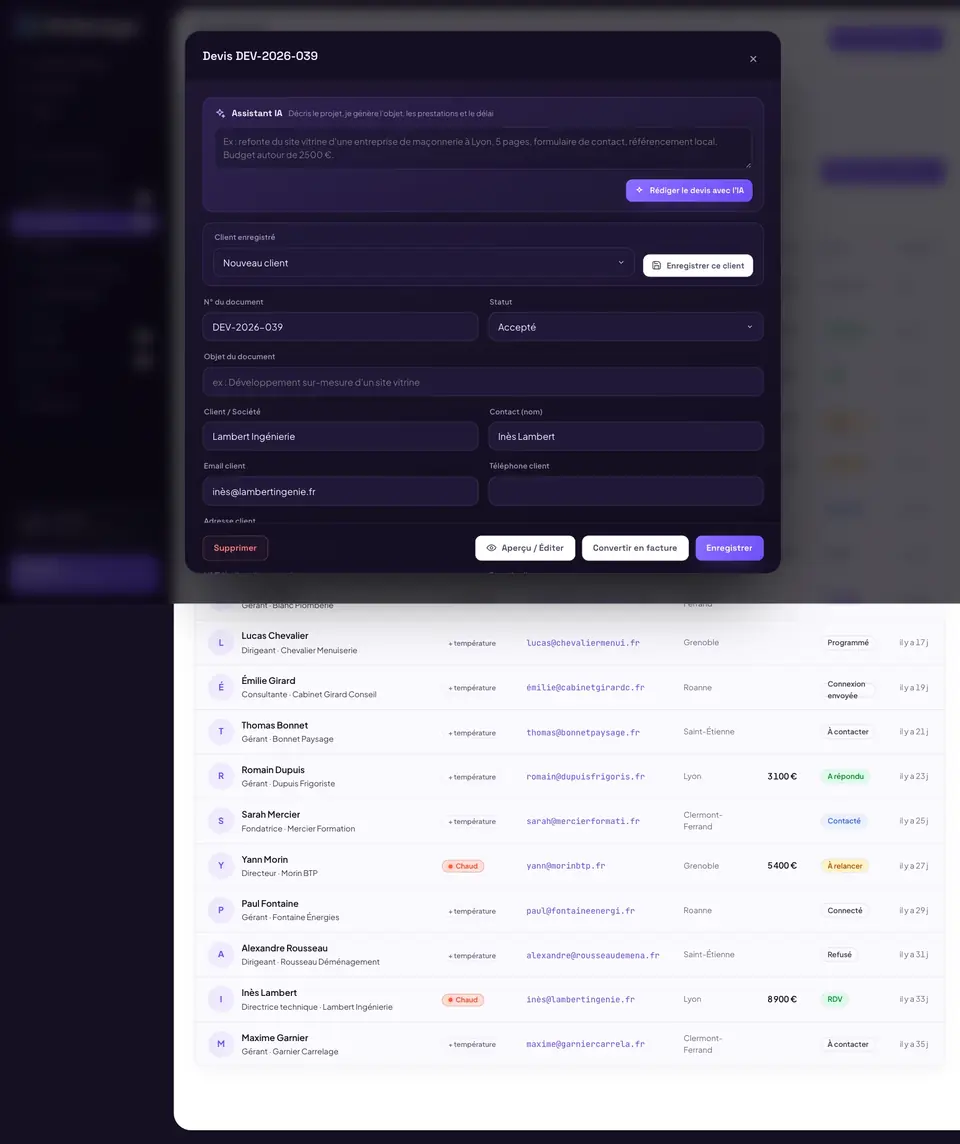
Prospecting and invoicing softwareHow did Widesign replace its spreadsheets with its own prospecting and invoicing software?Custom software · Prospecting and invoicing
Yanis Benkechida
contact@widesign.frToo expensive compared with what? A website that does not convert costs you lost quotes every month. Hours spent re-entering data, chasing and searching for a file cost just as much, without ever showing up on an invoice. Our prices are stated before we start, and you can judge the work before committing: a trial mock-up at €390 for a website, a scoping session at €490 for software, both deducted from the project. We do not start anything until that calculation seems obvious to you.
The right time is before you are overwhelmed, not during. A website is delivered in 14 days. For software, the timeline is fixed in writing at the scoping session. In both cases, we take on most of the work. And if you are going through a busy period, we plan the start date with you rather than rushing you.
If your website brings you regular enquiries and your tools keep up, keep them. If your team juggles spreadsheets, emails and paperwork, or if you no longer dare to show your website, it is quietly costing you. The first call is there to tell you honestly whether it is better to keep, improve or rebuild. Sometimes we advise a simple touch-up rather than a full project.
At first, yes. After that, you pay a per-user subscription that rises as your team grows, for a tool that imposes its own way of working and of which you only use a part. Custom software does what you need, nothing more, and it belongs to you. It is the same reasoning as with business premises: renting costs less in the first month, rarely over ten years.
That is why everything is written down before we start: what we deliver, at what price, by when. A single point of contact, steps approved one by one and 30 days of iterations included. Nothing is coded before you approve it. You keep every project document, and nothing important is decided verbally.
We need a scoping call, a few approvals and your content. For software, we start from the way you work today: you show it to us, we turn it into a tool. You decide, we build. In practice, most of your time goes into the scoping session, and the approvals after that are short.
You approve the mock-ups before any development, and you get 30 days of iterations included from the date the quote is signed. We keep reworking until you approve, within the scope agreed together, with no charge for revisions. And if the art direction does not suit you, we rework it before writing a single line of code.
No. Your website and your software belong to you, code and data included. You are trained to use them, and another professional can take over if you decide to. Access details, hosting and documentation are handed over to you on delivery, with nothing held back.
You choose. We can handle everything, hosting, backups and updates, or hand you the keys so that your usual provider can take care of it. Either way, access is in your name from day one, and you can change your mind along the way.
That is planned for. Custom software can be changed: we add a step, a field, a role, without rebuilding everything. Each change is priced separately and you decide whether it is worth the cost. That is the difference with an off-the-shelf tool, where you wait for the vendor to have the same idea as you.
Often, yes. We start by looking at what exists: what holds up, what is worth keeping, what costs more to fix than to rebuild. That is exactly what the scoping session is for, and sometimes it concludes that there is not much to throw away.
Your website isn't bringing you clients? Let's fix that.
30 minutes to understand what is holding things back and come away with a clear plan.
Opening the calendar…
Your message has arrived
A confirmation email has just been sent to you. We will reply in writing within 24 working hours.
Book a 30-minute callWould you rather talk it through? Book a 30-minute call
Cookies and privacy
We only use what is strictly necessary for the site to work. With your consent, we also measure visits to improve our pages. You can change your mind at any time. Learn more
Your preferences
Choose what you accept. Nothing is switched on until you have decided.
Essential for the site to work: remembering your cookie choice, sending forms, booking calls. They cannot be switched off.
Counts page views to understand what interests visitors. The data is hosted on our own server and is not passed on to any third party.
Remembers the pages you have viewed so we can tailor our replies and prepare a useful first conversation if you contact us.
Choice kept for 6 months. Privacy policy